The Importance of AEO in Local SEO for Healthcare Services

TL;DR
- The problem: Patients now get clinical answers from AI Overviews, AI Mode, and voice assistants before they ever visit a website, yet the "which provider do I book?" decision still runs through Google's local pack and Maps.
- The insight: AEO and local SEO are complementary. Clinical and informational queries are near-fully covered by AI answers, while Google removed AI Overviews from local "near me" provider searches, so clinics need both.
- The takeaway: Publish clear service and location pages, patient FAQs, structured data, and trustworthy medical content so engines can quote you and local systems can rank you.
The Importance of AEO in Local SEO for Healthcare Services
Patients no longer find a clinic the way they did five years ago. They ask a phone, read an AI-generated summary, skim reviews, and often decide before they ever pick up the phone. That shift is why the importance of AEO in local SEO for healthcare services now sits alongside traditional rankings on every serious healthcare marketing plan. Answer engine optimization (AEO) prepares your content to be read, understood, and quoted by AI systems, while local SEO keeps your practice visible when someone searches for care nearby. Used together, they make your services easier to find, easier to understand, and easier to trust.
What does AEO do for local healthcare search? Answer engine optimization structures a clinic's content so AI systems can quote it accurately. For local healthcare, that means AI Overviews and voice assistants can explain your services, hours, and insurance clearly, while patients still reach your booking page through Google Maps, the local pack, and organic results.
What is AEO, and how does it differ from local SEO?
AEO optimizes your content to be extracted and cited by AI answer engines; local SEO optimizes your practice to rank in geographic search results. They solve different halves of the same problem. Local SEO answers "where do I go?" through Maps, the local pack, and location pages. AEO answers "what should I know first?" by feeding clear, structured content into AI Overviews, Google's AI Mode, and assistants like Siri and Google Assistant.
The distinction matters because the two channels are converging in healthcare faster than almost anywhere else. Healthcare queries triggered AI Overviews around 72% of the time in 2024, rising to roughly 88% by December 2025, the highest rate of any industry tracked by BrightEdge. When a patient types or speaks a health question, an AI answer is now the most likely thing they see first.
Why does AEO matter for providers that rely on local search?
Because the questions that lead patients to your clinic are increasingly answered by AI before a single link is clicked, but the final "who do I book with?" decision still runs through local rankings. That split is the single most important thing for healthcare marketers to understand right now.
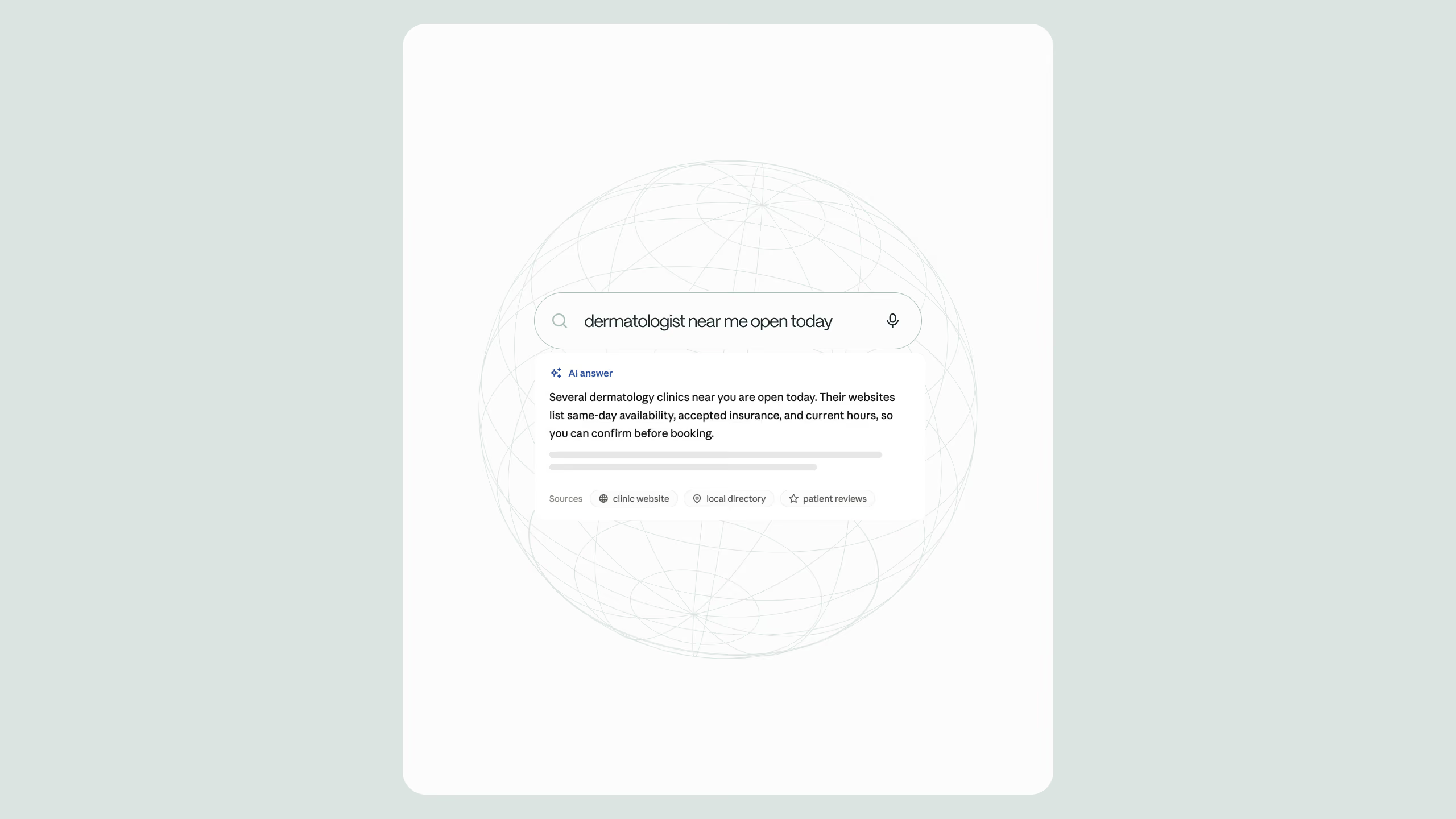
The nuance is well documented. BrightEdge found that treatment and procedure queries now show close to 100% AI Overview presence, with symptom and condition queries near 93%. Yet local, provider-intent searches such as "dermatologist near me" went from full AI Overview coverage in 2023 to essentially zero by December 2025, after Google tested the feature on those queries and then removed it. In other words, Google decided that clinical information belongs to AI, while provider selection belongs to traditional local results.
Do AI Overviews appear for "doctor near me" searches? As of December 2025, Google shows no AI Overviews on local provider-intent queries like "cardiologist near me," after testing and then removing them. BrightEdge puts local AI Overview coverage at 0%, while clinical queries such as treatments sit near 100%. Your local rankings still decide who patients actually see and book.
This is why AEO and local SEO are partners, not competitors. Your informational content (symptoms, treatments, conditions, preparation) earns visibility and citations in AI answers. Your local assets (Google Business Profile, location pages, reviews) win the appointment. A healthcare site optimized for only one leaves half the patient journey on the table.
The demand signal behind this is substantial. Google reports that roughly 5% of all searches are health-related, and that search drives about three times more visitors to hospital sites than non-search channels. On the AI side, OpenAI has indicated that over 5% of ChatGPT conversations are healthcare-related and that around a quarter of its weekly active users ask health questions. Patients are researching across both classic search and AI tools, and expecting clear answers in each.
In a recent Webflow build for a B2B client, Broworks drove a 284% increase in organic traffic by restructuring content around clear, answer-first pages with clean semantic markup,. the same structural discipline healthcare sites now need to be quoted by AI engines. The mechanics that make content extractable are largely platform-agnostic, but they're far easier to maintain on a system like where structure and schema are controllable without engineering bottlenecks.
How patients now search for nearby care
Patient behavior has fragmented across four distinct search moments, and each one demands a slightly different content response. Understanding where each moment resolves (AI answer, local pack, or your own page) is the core of a modern healthcare visibility strategy.
Patients now move through these moments in a typical journey:
- Symptom and condition research - "why does my shoulder hurt at night", usually answered by an AI Overview or AI Mode.
- Service confirmation - "does this clinic do allergy testing", answered by AI plus your service pages.
- Provider comparison - "best pediatric dentist near me", answered by the local pack, Maps, and reviews.
- Practical logistics - "do they take my insurance" and "are they open Saturday", answered by your profile and site.
- Voice and conversational queries - spoken, natural-language versions of all of the above.
Voice deserves specific attention. Industry analyses consistently find that roughly three-quarters of voice queries carry local "near me" intent, and voice searches are phrased as full questions rather than keywords. A patient rarely says "orthopedist Denver"; they say "find a five-star orthopedic surgeon near me who does knee replacement." Content written the way patients speak, in complete questions with concise answers, is what voice assistants and AI engines can lift directly.
The commercial stakes are high because visibility now equals access. Appeario's 2026 analysis reports that 77% of patients use search engines before booking, that Google handles about 92% of healthcare searches, and that the local pack captures roughly 42% of clicks for local medical searches. The same research notes that complete, regularly updated Google Business Profiles can receive around seven times more clicks than incomplete ones.
How healthcare websites support local SEO through AEO
By publishing clear, structured, trustworthy content that both AI engines and Google's local systems can read. The elements below do double duty, they make your information quotable in AI answers and strengthen the local signals that decide rankings.
The table below maps each patient search moment to where the answer now appears and what your site must provide.
To support both channels, a healthcare website needs a consistent content foundation:
- Clear, individual service pages
- Location-specific answers for each clinic
- Provider information and verifiable credentials
- FAQs covering the questions your front desk answers daily
- Visible insurance and appointment details
- Structured data (schema.org/MedicalOrganization and FAQPage)
- Reviews and reputation signals
- Trustworthy, expert-reviewed medical content
How do reviews and structured data affect AEO for clinics? Structured data helps engines read your services, locations, and FAQs; reviews signal trust. Together they make your practice easier to cite in AI answers and stronger in the local pack. Complete Google Business Profiles reportedly earn up to seven times more clicks than incomplete ones, compounding both effects.
How to structure a healthcare site for AEO and local rankings
Answer the patient's likely questions in the order they ask them, then mark that content up so machines can read it. A practical sequence:
- Map patient questions to funnel stages (symptom, service, provider, and booking) so every page has a job.
- Build one service page per treatment, opening with a two- to three-sentence plain-language answer before the detail.
- Create location pages with address, hours, insurance accepted, parking, and provider bios for each clinic.
- Add an FAQ section that answers insurance, appointment, and preparation questions in a patient's own words.
- Implement structured data (MedicalOrganization, Physician, and FAQPage) following Google's structured data guidance.
- Optimize and maintain your Google Business Profile and actively gather patient reviews.
- Keep medical content accurate and expert-reviewed to satisfy Google's YMYL and E-E-A-T standards.
Because healthcare is a "Your Money or Your Life" category, quality and accuracy are not optional. Healthcare also has the highest overlap between AI Overview citations and organic top-10 rankings of any industry, around 24%, which means the same authority that earns AI citations tends to earn strong local visibility too.
Measuring what matters
Track citations and calls, not just rankings. Because a growing share of searches end without a click (multiple analyses put zero-click Google searches near 60–69%) impressions and rankings alone will mislead you. Watch AI Overview presence for your priority queries, Google Business Profile actions (calls, direction requests, bookings), review velocity, and appointment conversions. In a bifurcated search environment, the practices that win are the ones that show up clearly in the AI answer and convert the patient once they land.
.svg)
.svg)