Negative AEO: Correcting Wrong AI Information About Your Brand

TL;DR
- AI engines like ChatGPT, Perplexity, and Gemini synthesize brand information from training data that may be months or years out of date making stale positioning, wrong service descriptions, and misattributed capabilities a genuine risk for any brand that has evolved since those models were trained.
- Most B2B marketing teams don't discover AI misinformation about their brand until it is already shaping early-stage buyer perception, which is why proactive auditing matters far more than reactive correction.
- Fixing it requires three parallel tracks: publishing authoritative updated content, strengthening entity signals across the web, and implementing structured data that gives AI engines a reliable, machine-readable source of current brand truth.
What Is Negative AEO?
Unlike negative SEO, which involves deliberate manipulation of search rankings through spammy tactics, negative AEO is rarely adversarial. It is structural: a byproduct of stale training data, gaps in your brand entity footprint, or errors in third-party content that AI systems weighted too heavily during training.
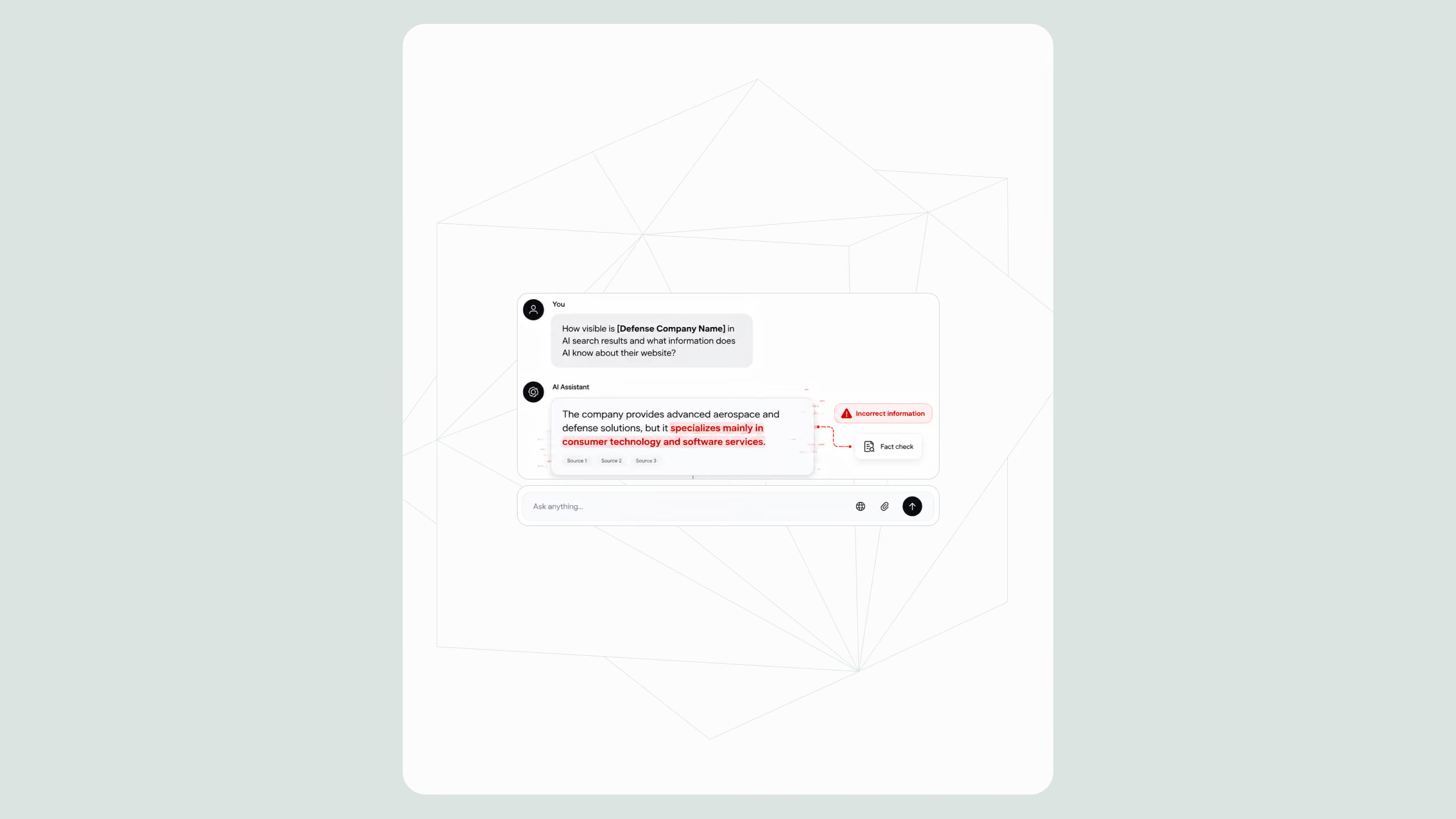
The problem is more widespread than most marketing teams recognize. AI engines do not browse the web in real time for most queries, they generate responses based on patterns learned during training, which can be months or years behind the current state of your brand. If your company has rebranded, pivoted its positioning, restructured its pricing, or expanded its services, there is a material risk that major AI tools are still describing you as you were, not as you are. For marketing directors and CMOs responsible for controlling brand narrative, that is a significant and systematically underestimated exposure.
Why Do AI Engines Get Your Brand Wrong?
AI engines get your brand wrong primarily for three reasons: stale training data, weak brand entity signals, and third-party content errors. Understanding each cause is essential to knowing which correction lever to pull first.
Stale Training Data
Large language models are trained on datasets scraped from the web up to a specific cutoff point. After training, they have no automatic mechanism to update their understanding of a brand, even as that brand evolves significantly. If your company's training data is 18 months old and you have since restructured your service offering or repositioned entirely, the model will continue surfacing your old messaging with the same confidence as if it were current fact.
This is particularly damaging for fast-moving companies: SaaS startups that have pivoted their core product, agencies that have narrowed or expanded their focus, or enterprise brands that have undergone mergers, acquisitions, or rebrands. The more your brand has changed relative to its historical web presence, the higher your exposure to negative AEO from training data that no longer reflects reality.
Weak Brand Entity Signals
AI engines do not just train on raw content, they develop entity graphs that map relationships between companies, products, services, and concepts. If your brand has a thin entity footprint (inconsistent descriptions across directories, limited mentions in authoritative publications, no structured data markup on your website) AI engines will fill in the gaps with inference or blended information from similar-sounding companies in the same category.
The result is misattributed features, confused positioning, or descriptions that are plausible but wrong. For B2B brands competing in crowded SaaS verticals where differentiation is hard-won, being described as a generic version of what you actually do is its own category of brand damage.
Third-Party Content Errors
Review platforms, comparison sites, press coverage, and industry directories all feed into AI training pipelines. If a third party has published incorrect information about your company (a discontinued service still listed as active, an outdated pricing tier, a misrepresented service scope) that information may have been absorbed into training data. Because AI engines weight sources by perceived domain authority, a single inaccurate entry on a high-authority comparison platform can persist in AI-generated outputs long after you have corrected it on your own properties.
How to Identify Negative AEO in the Wild
Negative AEO does not generate ranking alerts, conversion tracking signals, or CRM flags. It operates silently at the top of your funnel, shaping perception before a prospect ever reaches your website. Surfacing it requires active investigation.
- Run direct brand queries across every major AI tool. Open ChatGPT, Perplexity, Gemini, and Bing Copilot separately. Ask each: "What does [company name] do?", "What services does [company name] offer?", "Who does [company name] typically work with?", and "How is [company name] different from [key competitor]?" Document outputs exactly as generated, noting where descriptions are inaccurate, outdated, or missing.
- Test category and positioning queries. Do not limit your audit to brand-name searches. Ask about the specific problems you solve and the categories you compete in to see whether your company is included and if so, how accurately it is positioned relative to what you actually offer.
- Check for competitor misattribution. AI engines sometimes blend descriptions between similar-sounding brands, especially in crowded categories. Searching for competitors can surface cases where your company is mentioned in ways that distort your actual positioning or capabilities.
- Audit your third-party data sources. Review your listings on Crunchbase, G2, Capterra, LinkedIn Company Pages, and industry-specific directories for outdated descriptions, discontinued services, or incorrect pricing. These sources carry enough domain authority to influence AI-generated outputs even when your own content is accurate.
- Use dedicated AEO monitoring platforms. Tools like Profound, Scrunch AI, and Search Atlas are built specifically to track how AI engines describe brands over time, allowing you to set a baseline and monitor for shifts in AI-generated brand descriptions across different models.
- Verify how your proprietary data is being cited. If your company has published original research, case studies, or documented client outcomes, check whether AI tools referencing them are representing the data accurately and in context.
Why Negative AEO Is a Real Business Risk
For B2B companies where deal cycles are long and initial framing is difficult to correct, AI-generated brand misinformation creates direct pipeline risk. A buyer who starts their vendor research in ChatGPT or Perplexity may arrive at a sales conversation already holding an inaccurate picture of your pricing, capabilities, or service scope. Your team then spends time correcting a false narrative before it can advance the conversation, and some buyers will not reach out at all if what AI tools tell them does not match what they need.
The brands most exposed to this kind of negative AEO share a recognizable profile:
- A history of rebranding, product pivots, or significant positioning shifts
- Service portfolios that have expanded, contracted, or been renamed
- Minimal presence in authoritative third-party publications
- No structured data markup implemented on the company website
- Core website pages that have not been updated in 12 months or more
- Inconsistent brand descriptions across company profiles and directory listings
As AI-assisted research becomes a more embedded step in B2B vendor evaluation, brands that have not addressed their AI-visible entity footprint are effectively ceding control of their brand narrative to systems that may be describing them inaccurately at the most consequential point in the buyer journey.
The Correction Process: How to Fix Negative AEO for Your Brand
Correcting negative AEO is not a single tactic, it is a systematic, multi-track effort. There is no quick patch that overrides stale training data overnight. But the correction process is well-defined, and brands that execute it consistently see measurable improvement in how AI engines describe them.
Step 1: Publish Authoritative, Updated Content
The most direct signal you can send to AI engines is publishing accurate, well-structured content that explicitly states the correct information about your brand — in plain language, not marketing copy. In practice, this means:
- Updating core service and about pages to reflect your current positioning, scope, and language
- Publishing long-form articles that directly address the queries where AI tools are currently describing you incorrectly
- Creating answer-oriented content structured around the exact questions AI engines are being asked about your brand, declarative statements, not vague descriptions
AI engines prioritize content that is specific, factual, and contextually rich. Vague, benefit-heavy marketing copy gives them nothing concrete to extract. Direct, entity-rich content structured around clear claims gives them something they can cite accurately.
Step 2: Strengthen Your Brand Entity Signals
Entity signals are the interconnected web of consistent, authoritative references to your brand that help AI engines converge on an accurate understanding of who you are and what you offer. To build them meaningfully:
- Ensure your company name, core service description, and key differentiators are described consistently across your website, LinkedIn, Crunchbase, G2, and any major industry directories
- Earn mentions in credible, industry-relevant publications press coverage, guest bylines, and analyst inclusions carry significant entity authority
- Review your Wikipedia or Wikidata entry if one exists; inaccurate or absent entries in these sources carry disproportionate influence on AI model outputs
Consistency across authoritative sources is the governing variable. When AI engines encounter the same accurate brand description across dozens of high-authority sources, they converge on that description and surface it reliably across query types.
This is not just a theoretical framework. When Broworks restructured the content architecture and entity visibility strategy for Frontera, a B2B recruitment technology company, the combination of consistent brand signals, cleaner content structure, and improved entity-level coverage contributed to over 200% organic traffic growth, a result that illustrates how content and entity signals work together in AI-influenced search environments.
Step 3: Use Structured Data to Override Outdated Information
Structured data provides a machine-readable layer of brand truth that AI engines and search engines can prioritize over older or conflicting sources. For negative AEO correction specifically, the highest-impact schema types are:
- Organization schema: your legal name, URL, founding details, service areas, and social profiles
- Service schema: detailed, current descriptions of each service you offer, including scope and intended audience
- FAQPage schema: direct question-and-answer pairs targeting the most common queries about your brand, services, and positioning
- BreadcrumbList schema: reinforcing the hierarchy and thematic structure of your content
Implementing these correctly on your Webflow website establishes a machine-readable source of record that AI engines can reference with confidence. According to Google's structured data documentation, well-implemented schema markup directly improves how search and AI systems interpret and surface your content, which is precisely the outcome a negative AEO correction strategy is designed to achieve.
Step 4: Monitor, Re-Audit, and Iterate
Negative AEO correction is not a one-time sprint. AI models are periodically retrained, the broader content landscape shifts, and third-party sources update independently of your own properties. A sustainable correction posture includes:
- A quarterly brand query audit across ChatGPT, Perplexity, Gemini, and Bing Copilot
- Ongoing monitoring of your entity footprint for newly introduced inaccuracies or stale descriptions on third-party platforms
- A structured content update process that keeps core positioning pages current as your brand evolves
Brands that treat their AI-visible content footprint as ongoing infrastructure, not a one-time project, consistently achieve more accurate representation across AI engines. Those that address negative AEO reactively tend to discover damage only after it has already shaped pipeline.
Negative AEO vs. Proactive AEO: What Separates Brands That Get Cited Correctly
What Happens If You Ignore Negative AEO?
Leaving negative AEO unaddressed means allowing AI-generated misinformation about your brand to compound over time, shaping early-stage buyer perception before your sales or marketing team has any opportunity to intervene. As AI-assisted vendor research becomes a default step in the B2B buying process, the gap between your actual positioning and your AI-visible positioning becomes a revenue risk that does not surface in standard analytics dashboards until it has already affected qualified pipeline.
Brands that discover negative AEO damage typically do so retroactively: a deal that stalled because a prospect had wrong pricing assumptions, a competitive loss to a brand that AI tools consistently recommend more accurately, or a categorical absence from shortlists your company should have appeared on. None of these show up as an alert, they show up as a gap in performance you have to trace backward to find.
Negative AEO is correctable. But the cost of correction rises over time, because misinformation that persists across multiple model training cycles becomes progressively harder to displace. The brands with the strongest AI-visible presence are those that started treating entity signals and authoritative content as infrastructure before they needed to, not after a buyer cited the wrong version of their company in a discovery call.
For a structured starting point, the Broworks AEO resources library covers how to audit AI brand visibility, structure entity-rich content, and implement schema for maximum AI extractability. The full AEO content library on the Broworks blog also contains in-depth guides on entity optimization and AI search strategy for B2B brands.
.svg)
.svg)