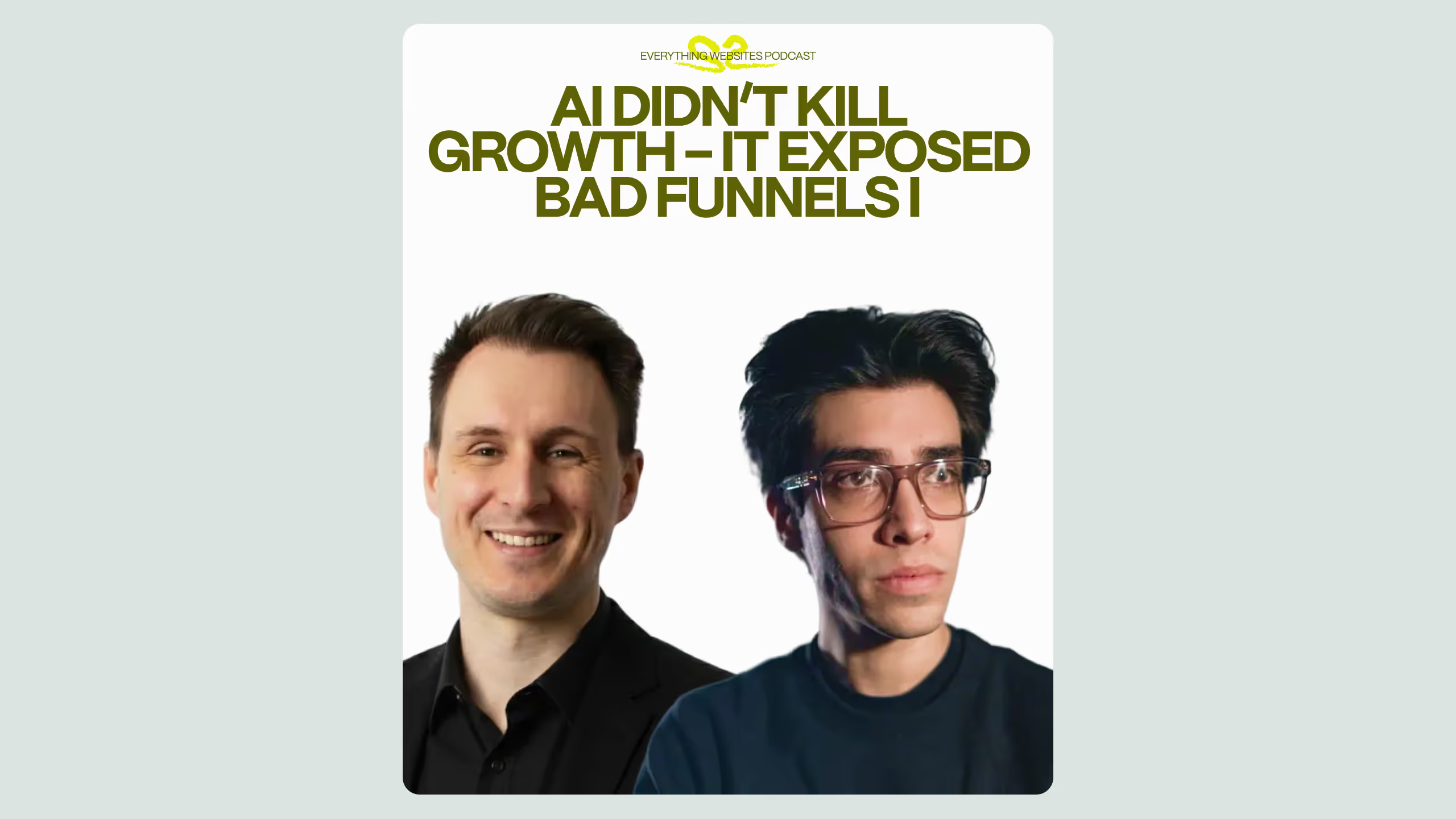
AI Didn't Kill Growth, It Exposed Bad Funnels
TL;DR
AI search optimization for websites does not require abandoning traditional SEO, it demands executing fundamentals with greater precision. Websites succeeding in 2026 combine schema markup, accessibility compliance, fast performance, and niche positioning to become the definitive sources AI engines cite. The shift from traditional search to AI-mediated discovery exposes conversion funnels built on friction rather than value. Brands that invest in clarity, structured content, and genuine differentiation will compound visibility over 18 to 24 months, while those chasing algorithmic shortcuts will remain invisible. AI did not kill growth, it revealed which websites deserved attention in the first place.
How AI Search Is Rewriting the Rules of Website Discovery and Conversion
The shift from traditional search engines to AI-powered answer engines represents more than a technological update, it exposes fundamental weaknesses in how websites approach user acquisition and conversion. While many brands focus on blaming AI for declining traffic, the reality is that AI search optimization for websites reveals which companies built genuine value and which relied on friction-heavy funnels disguised as user experience.
Sebastian Bimbi, a Webflow Community MVP and systems thinker who has spent years optimizing enterprise websites, sees this transition differently. Rather than mourning the death of traditional SEO, he views AI search as an opportunity to rebuild websites around clarity, speed, and genuine user value. The brands succeeding in 2026 are not those fighting against AI, they are the ones who recognized that AI simply accelerates what already worked: serving the right answer to the right person at the right moment.
The conversation around AI and websites often centers on technical optimization, but the deeper truth is strategic. Websites that convert in the AI era are built for users who arrive informed, skeptical, and ready to evaluate. The question is no longer whether your site ranks, it is whether your site deserves the click when users finally arrive.
Understanding the Zero-Click Search Phenomenon
The rise of AI-powered search engines like ChatGPT, Perplexity, and Google's AI mode has fundamentally altered user behavior. Users no longer begin their journey on your homepage. They arrive mid-funnel, armed with knowledge about alternatives, pricing ranges, and competitive positioning. This shift creates both a challenge and an opportunity.
Traditional SEO focused on capturing users at the awareness stage and guiding them through education. AI search optimization for websites requires a different approach. Users now bypass the educational content entirely, arriving at your site only when they are ready to evaluate specific solutions. This means impressions increase while clicks decrease, a pattern many marketing teams misinterpret as failure.
The reality is more nuanced. Higher impressions with fewer clicks indicate stronger brand awareness and topical authority. AI engines are citing your content without requiring users to visit your site for basic information. When users do click through, they are higher-intent prospects who have already completed their initial research.
However, this efficiency only benefits websites built for conversion. Sites that relied on educating unqualified traffic or using content to mask weak value propositions now face a reckoning. AI search does not kill growth, it exposes bad funnels that depended on information asymmetry rather than genuine differentiation.
The Three-Second Rule in an AI-First World
Sebastian Bimbi emphasizes a fundamental truth about user behavior that becomes even more critical in the AI search era: websites have three seconds to capture attention or users bounce. This is not new, but AI search makes it unforgiving. Users arriving from AI-powered recommendations have already seen your core messaging summarized. If your website fails to immediately validate that AI-provided summary or add substantial new value, users leave.
The solution is not more content or flashier design. It is ruthless clarity about who you serve and what outcome you deliver. Websites must answer the core user question within the hero section: "Is this for me, and what will I gain?" Anything less results in immediate abandonment.
This clarity extends beyond messaging to site architecture. AI engines prioritize websites that organize information hierarchically, making it trivial for both humans and machines to extract key facts. Vague positioning, buried CTAs, and generic language create friction that AI users will not tolerate. They have already seen alternatives, your job is to prove you are the right choice, not to explain why they need a solution at all.
Component-based design becomes essential in this context. Websites built with reusable, structured components not only load faster and maintain visual consistency, they also communicate clear information hierarchies to AI engines. Broworks implements this approach through frameworks like Lumos and Client-First, ensuring every page element serves both user comprehension and machine readability.
Building for AEO Without Abandoning SEO
Answer Engine Optimization (AEO) is not a replacement for SEO, it is an evolution. The fundamentals remain: authoritative content, clean technical implementation, fast page speeds, and strategic keyword targeting. What changes is the execution layer. AI engines require explicit signals about content meaning, relationships, and entity definitions.
Schema markup becomes non-negotiable. While traditional SEO could sometimes succeed without structured data, AI search optimization for websites demands it.
Schema tells AI engines what your content represents, how it relates to other entities, and which facts should be extracted for answers. Google's AI mode, ChatGPT, and Perplexity all prioritize sources with clear entity definitions and relationship mapping.
Webflow's recent introduction of AI-generated schema markup accelerates this process, but Sebastian warns against over-reliance on automation. AI-generated schema provides a foundation, but human review ensures accuracy and strategic alignment. The goal is not just technical compliance, it is becoming the definitive source AI engines cite when answering user queries in your domain.
This requires content structured for quotability. AI engines extract specific facts, definitions, and data points. Websites that bury key information in dense paragraphs or fail to provide citation-worthy statements lose visibility. The solution is writing that balances narrative flow with extractable insights, short, definitive sentences that AI can attribute and users can verify.
Internal linking also shifts from an SEO tactic to an AEO necessity. Transactional internal links between related topics help AI engines map your topical authority. Rather than linking for the sake of crawl depth, link to create semantic relationships. Every link should answer the implicit question: "What else does this organization know about this topic?"
The Five Pillars of AI-Ready Website Performance
Sebastian identifies five critical elements that determine whether a website succeeds in AI-mediated search:
- Schema Markup Implementation
Every page should define its primary entity, relationships to related concepts, and factual claims that deserve citation. This is not optional metadata, it is the language AI engines use to understand your expertise.
- Accessibility Compliance
AI engines prioritize content that follows semantic HTML standards, provides alt text for images, and maintains logical heading hierarchies. Poor accessibility signals low content quality to both users and algorithms.
- Consistent Keyword Integration
While keyword density matters less than in traditional SEO, strategic placement in H1, H2, and opening paragraphs helps AI engines categorize your content correctly. The key is natural integration that serves user comprehension first.
- Domain Authority Through Backlinks
AI engines, like traditional search algorithms, weight citations from high-authority domains more heavily. The difference is that AI can synthesize information across multiple sources, meaning your backlink profile must establish you as a primary source, not just a participant in the conversation.
- Website Performance Optimization
Large Language Models (LLMs) analyzing your content for citation do not have infinite patience. Slow-loading pages, excessive JavaScript, and poor Core Web Vitals reduce the likelihood of being indexed for AI search results. Broworks targets 100-point Lighthouse scores not for vanity but because speed directly correlates with AI visibility.
These five pillars work synergistically. Excellent schema markup cannot compensate for poor accessibility. Fast load times mean nothing without authoritative backlinks. AI search optimization for websites requires holistic execution, not isolated tactics.
Why Niche Positioning Matters More Than Ever
One of Sebastian's most emphatic recommendations centers on niche focus. In traditional SEO, broad positioning could capture diverse traffic. In AI search, specificity determines whether you are cited at all. AI engines recommend the top 1% of sources in any given category. If you are not definitively the best at something specific, you are invisible.
This creates strategic pressure to narrow focus. B2B SaaS companies cannot optimize for "software" or even "project management software" and expect AI visibility. They must own a specific use case, audience segment, or methodology. The tighter the niche, the higher the likelihood of becoming the AI-recommended answer.
Broworks demonstrates this principle by focusing explicitly on Webflow development for B2B SaaS and enterprise brands. Rather than competing as a general web design agency, they position around a specific platform, audience, and outcome. This specificity makes them the logical AI recommendation when users ask about Webflow migration, CRO optimization in Webflow, or enterprise-grade Webflow builds.
Niche positioning also enables better content strategy. When you know exactly who you serve, you can create content that answers their precise questions in their language. This specificity increases the likelihood that AI engines will extract and cite your content because it provides definitive answers rather than generalized overviews.
The risk of niche positioning, that you exclude potential customers, is real but overstated. In AI search, being the second-best option for everyone means being invisible. Being the definitive choice for a specific segment means capturing all demand within that segment, with spillover to adjacent audiences who discover your expertise and adapt.
Content Architecture for AI Citation
Creating content that AI engines cite requires rethinking traditional blog structure. Long-form articles still have value, but they must be architected for extraction. This means integrating standalone answer blocks, 2 to 4 sentence paragraphs that provide complete, quotable responses to specific questions.
These answer blocks serve dual purposes. For human readers, they provide scannable summaries that improve comprehension. For AI engines, they represent ideal citation targets, complete thoughts that can be extracted without requiring additional context. Websites that integrate 3 to 5 answer blocks per article dramatically increase their AI citation rate.
FAQ sections become strategic rather than supplementary. AI engines prioritize FAQ content because it explicitly maps questions to answers. However, generic FAQs provide minimal value. Effective FAQ sections target long-tail queries, use natural language that mirrors how users ask questions verbally, and provide substantive 50 to 120 word answers that stand alone.
Table integration also improves AI extractability. Comparison tables, feature matrices, and data visualizations provide structured information that AI engines can parse and cite. Including descriptive alt text ensures even image-based tables contribute to your AI visibility.
The goal is not to game AI algorithms but to recognize how AI engines consume and synthesize information. Content that is clear, well-structured, and definitively answers specific questions will always outperform vague, poorly organized material, regardless of whether the reader is human or machine.
The Persistence Required to Win in AI Search
Both Stefan and Sebastian emphasize that success in AI search optimization for websites requires long-term commitment. Websites do not achieve AI visibility in weeks or even months. Building topical authority, earning quality backlinks, and establishing entity recognition takes 18 to 24 months minimum.
This timeline discourages many teams, especially those accustomed to paid acquisition's immediate feedback loops. However, the compounding returns of AI visibility make the investment worthwhile. Once established as a primary source in your niche, AI engines continue citing your content without requiring ongoing ad spend.
The key is avoiding the temptation to chase short-term wins at the expense of long-term authority. Publishing low-quality content to hit volume targets, buying backlinks from irrelevant sources, or stuffing keywords all create technical debt that undermines AI visibility.
AI engines are trained to detect manipulation, the only sustainable path is genuine expertise, clearly communicated. This does not mean waiting passively for results. Successful teams implement systematic testing: publishing different content structures, monitoring which formats get cited, and iterating based on data. They also leverage AI tools to accelerate research and drafting, while maintaining human oversight for accuracy and strategic alignment.
Sebastian's career trajectory illustrates this patience. It took 4 to 5 years to achieve recognition in the Webflow community, not because the work was slow, but because building genuine expertise and trust cannot be rushed. The same principle applies to AI search, shortcuts fail, but consistent execution compounds.
When AI Is Not the Enemy but the Accountability Mirror
The central thesis of the conversation between Stefan and Sebastian is that AI did not break website growth, it revealed which websites were built on weak foundations. Brands that relied on information asymmetry, vague positioning, or friction-heavy funnels are struggling not because AI is unfair, but because AI eliminates the advantages that masked their weaknesses.
Conversely, brands that invested in genuine differentiation, clear communication, and user-centric design are thriving. AI search optimization for websites rewards the fundamentals: fast load times, authoritative content, semantic structure, and conversion-focused UX.
These elements always mattered, AI just makes their absence impossible to ignore. This perspective shift is critical for marketing teams evaluating their AI strategy. The question is not "How do we optimize for AI?" but rather "What weaknesses is AI exposing that we should have fixed already?" Schema markup, accessibility, page speed, and content clarity are not AI-specific tactics. They are baseline requirements for modern web experiences.
The brands winning in AI search are those that view optimization as continuous improvement rather than a one-time project. They audit sites quarterly, test new content structures, monitor AI citation rates, and iterate based on data. They recognize that AI search behavior will continue evolving, the only sustainable response is building adaptable systems rather than chasing algorithmic trends.
Practical Steps for Teams Starting AI Optimization Today
For marketing teams ready to improve their AI visibility, Sebastian recommends starting with schema markup implementation. This single change provides the clearest signal to AI engines about your content's meaning and relationships. Webflow's native schema generation offers a starting point, but custom schema tailored to your specific entities and claims will always outperform generic templates.
Next, audit your hero sections across key landing pages. Do they answer the core user question "Is this for me and what will I gain?", within three seconds? If not, simplify messaging until the value proposition is immediately obvious. AI users have less patience than traditional organic visitors because they arrive with higher expectations.
Third, restructure long-form content to include extractable answer blocks. Review your top-performing blog posts and identify the 3 to 5 key insights AI should cite. Rewrite those sections as standalone 2 to 4 sentence paragraphs that provide complete answers without requiring additional context.
Fourth, implement component-based design for new pages and templates. This prevents future technical debt and ensures consistent schema implementation across your site. Webflow's component system makes this straightforward, the challenge is organizational discipline to actually use components rather than duplicating elements.
Fifth, commit to the 18 to 24 month timeline required for meaningful results. AI visibility compounds slowly but predictably. Teams that execute consistently without chasing shortcuts will outperform those that oscillate between aggressive tactics and neglect.
More resources
.svg)
.svg)

Ultimate site performance checklist